
Experiential Learning School Education at GNWS supports holistic education through practical learning, moral education in schools, and value education.
Moreover, this approach strengthens holistic education, supports value education in schools, and reinforces moral education in schools. Consequently, learners grow academically, emotionally, socially, and ethically. This article explores why experiential learning matters so much in school education and how Greater Noida World School implements it effectively.
Understanding Experiential Learning in School Education
Experiential learning focuses on direct experience as the foundation of learning. Instead of passively absorbing information, students actively participate in activities, experiments, projects, and real-life problem-solving. Therefore, learning becomes meaningful, memorable, and practical.
At Greater Noida World School, experiential learning does not function as an extra activity. Instead, it forms a core teaching methodology. Consequently, subjects such as science, mathematics, social studies, languages, and even moral education are taught through hands-on engagement.
Moreover, this approach encourages curiosity and critical thinking. As a result, students ask questions, explore possibilities, and discover answers independently. Hence, learning transforms into an enjoyable journey rather than an academic burden.
Why Experiential Learning Matters in Modern School Education
Traditional classroom learning often focuses on rote memorisation. However, such learning rarely prepares students for real-life challenges. Therefore, experiential learning becomes essential in today’s dynamic world.
Firstly, experiential learning improves understanding. When students perform experiments or work on projects, they understand concepts deeply. Secondly, it builds confidence. Students feel empowered when they solve problems independently. Thirdly, it enhances retention. Practical experiences stay in memory longer than written notes.
At Greater Noida World School, these benefits are clearly visible. Consequently, students demonstrate better academic performance, stronger communication skills, and higher emotional intelligence.
Experiential Learning as the Foundation of Holistic Education
Holistic education focuses on the overall development of a child. It nurtures intellectual, emotional, physical, social, and ethical growth. Experiential learning naturally supports this philosophy.
At Greater Noida World School, learning extends beyond classrooms. Therefore, sports, arts, leadership activities, community engagement, and creative projects receive equal importance. Moreover, students learn teamwork, empathy, resilience, and responsibility through experience.
As a result, learners develop balanced personalities. They do not grow only as exam scorers but as confident individuals ready for life. Hence, holistic education becomes a lived reality, not just a theoretical concept.
Role of Experiential Learning in Moral Education in Schools
Moral education in schools shapes character, ethics, and values. However, moral values cannot be taught effectively through lectures alone. Instead, they must be experienced.
At Greater Noida World School, moral education is integrated into daily school life. Therefore, students participate in group activities, peer collaboration, and community service. Through these experiences, they learn honesty, respect, compassion, and responsibility.
For example, collaborative projects teach fairness and teamwork. Similarly, leadership roles encourage accountability. Consequently, students internalise moral values naturally.
Moreover, experiential learning helps students understand the impact of their actions. As a result, moral education becomes practical and meaningful rather than abstract.
Strengthening Value Education in Schools Through Experience
Value education in schools focuses on developing responsible citizens with strong ethical foundations. Experiential learning plays a vital role in achieving this goal.
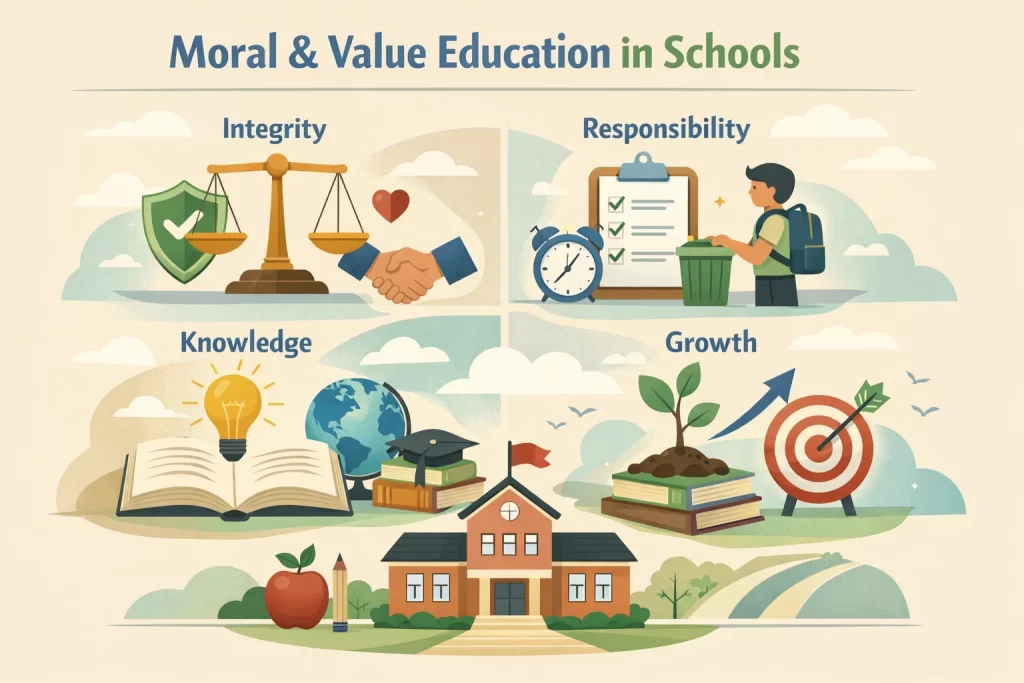
At Greater Noida World School, values such as integrity, empathy, discipline, and respect are taught through activities rather than sermons. Therefore, students learn values by practising them daily.
For instance, participation in social outreach programmes helps students understand social responsibility. Similarly, environmental projects foster respect for nature. Consequently, values become habits rather than lessons.
Furthermore, experiential learning encourages self-reflection. Students evaluate their actions and decisions. Hence, value education becomes deeply personal and impactful.
Experiential Learning in Academic Subjects at GNWS
Experiential learning at Greater Noida World School is not limited to co-curricular activities. Instead, it is embedded in academics as well.
- Science is taught through experiments, observations, and practical demonstrations.
- Mathematics concepts are explained using real-life applications and problem-solving tasks.
- Social studies involve debates, role-plays, and project-based learning.
- Languages are strengthened through storytelling, presentations, and creative expression.
Therefore, students connect theory with practice. As a result, learning becomes relevant and engaging.
Building Life Skills Through Experiential Learning
Life skills play a crucial role in long-term success. Experiential learning helps develop these skills naturally.
At Greater Noida World School, students gain communication skills through presentations and discussions. Moreover, teamwork is developed through group projects. Additionally, leadership skills emerge through student-led initiatives.
Problem-solving and decision-making abilities also improve through experiential tasks. Consequently, students become independent thinkers.
Furthermore, emotional intelligence grows when students interact, collaborate, and resolve conflicts. Hence, experiential learning prepares students for both professional and personal life.
Experiential Learning and Emotional Well-being
Academic pressure affects many students today. Experiential learning helps reduce stress and anxiety by making learning enjoyable.
At Greater Noida World School, students feel motivated rather than pressured. Therefore, they participate actively and express themselves freely. Moreover, creative activities provide emotional outlets.
As a result, students develop self-confidence and emotional balance. Hence, experiential learning supports mental well-being alongside academic growth.
Preparing Students for the Future Through Experiential Learning
The future demands adaptability, creativity, and practical knowledge. Experiential learning equips students with these skills early.
At Greater Noida World School, students learn to apply knowledge in real situations. Therefore, they become better prepared for higher education and careers.
Additionally, exposure to real-world challenges builds resilience. Consequently, students learn to handle uncertainty and change confidently.
Thus, experiential learning ensures that education remains future-ready.
Parent and Teacher Collaboration in Experiential Learning
Experiential learning thrives when parents and teachers work together. At Greater Noida World School, educators actively involve parents in the learning journey.
Workshops, exhibitions, and interactive sessions allow parents to witness experiential learning in action. Therefore, trust and transparency are built.
Moreover, teachers act as facilitators rather than instructors. They guide students through experiences instead of delivering one-way lectures. Hence, learning becomes collaborative and supportive.
Why Greater Noida World School Stands Out
Many schools talk about experiential learning. However, Greater Noida World School implements it consistently and thoughtfully.
The school integrates experiential learning across academics, values, and personal development. Therefore, students receive a complete educational experience.
Moreover, the focus on holistic education, moral education in schools, and value education in schools sets GNWS apart. Consequently, learners emerge as confident, ethical, and capable individuals.
Conclusion
Experiential learning has transformed modern school education. It bridges the gap between theory and practice while nurturing the whole child. Greater Noida World School (GNWS) has successfully embraced this approach to create meaningful, engaging, and future-ready education.
Through experiential learning, GNWS promotes holistic education, strengthens moral education in schools, and reinforces value education in schools. As a result, students do not just learn lessons—they learn life.
Frequently Asked Questions (FAQs)
1. What is experiential learning in school education?
Experiential learning involves learning through direct experience, activities, and reflection. It helps students understand concepts by doing rather than memorising.
2. How does Greater Noida World School implement experiential learning?
Greater Noida World School integrates experiential learning into academics, co-curricular activities, moral education, and value education through projects, experiments, and real-life applications.
3. How does experiential learning support holistic education?
Experiential learning develops intellectual, emotional, social, physical, and ethical skills together. Therefore, it supports complete personality development.
4. Why is experiential learning important for moral and value education in schools?
Moral education in schools and value education in schools become effective when students experience values in action. Experiential learning helps students practise ethics, responsibility, and empathy daily.