
A child’s academic journey does not begin with difficult examinations or lengthy textbooks. It starts with learning to read a sentence, understand numbers, ask questions and explain ideas with confidence. These early abilities influence how comfortably children approach more advanced subjects in later classes.
The best primary schools understand that strong academic foundations are built gradually. They focus on conceptual clarity, effective teaching, regular practice and the overall development of each child. Instead of measuring progress only through marks, they help students understand what they learn and apply it in everyday situations.
In India, this approach also aligns with the National Education Policy (NEP) 2020 and the NIPUN Bharat Mission, which emphasise foundational literacy and numeracy during the early years of schooling.
1. They Prioritise Reading, Writing and Numeracy
Reading, writing and mathematics are the building blocks of primary education. Children who develop these skills early can understand instructions, communicate ideas and approach new subjects with greater confidence.
Effective primary schools give students regular opportunities to:
- Read stories, short passages and age-appropriate books.
- Develop vocabulary and sentence formation.
- Practise handwriting, spelling and creative writing.
- Understand numbers, patterns and basic calculations.
- Solve simple mathematical problems using practical examples.
For example, teachers may use objects, number cards and counting activities to explain addition and subtraction. Similarly, storytelling and reading sessions help children understand language instead of simply memorising words.
The objective is not just to complete the syllabus but to ensure that children understand essential concepts.
2. They Make Learning Activity-Based and Practical
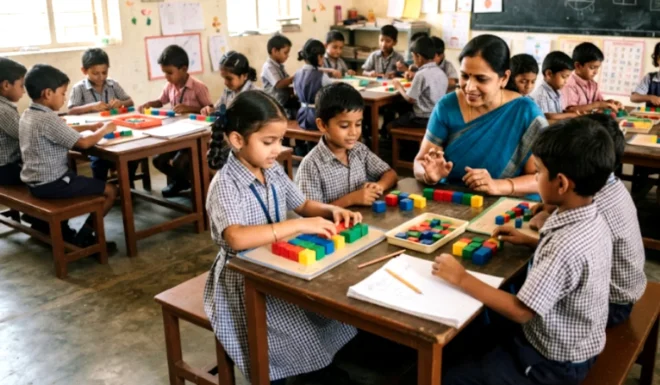
Young learners often understand concepts more effectively when they can see, touch, explore and experience them.
Therefore, strong primary schools combine classroom explanations with practical activities. Instead of teaching every topic through textbooks, teachers use games, experiments, demonstrations and group exercises.
For instance:
- Mathematics becomes easier through counting objects and measuring classroom items.
- Environmental studies becomes more interesting through nature walks and observation activities.
- Science concepts can be introduced through simple experiments.
- Language skills improve through storytelling, role-play and classroom discussions.
These activities connect academic concepts with everyday experiences. Consequently, children become active participants rather than passive listeners.
3. They Focus on Conceptual Understanding Instead of Rote Learning
Memorising answers may help children perform in certain examinations, but it does not always mean they understand the subject.
The best primary schools encourage students to understand why something happens and how a particular answer is reached.
Consider a simple mathematics question: instead of asking children to memorise multiplication tables alone, teachers can demonstrate multiplication through groups of objects. Similarly, a science lesson about plants becomes more meaningful when students observe how a seed grows.
This approach develops:
- Logical reasoning
- Problem-solving abilities
- Independent thinking
- Better memory and understanding
- Confidence in explaining answers
When students understand the logic behind a topic, they can use that knowledge in different situations.
4. They Provide Individual Attention to Students
Every child learns differently. Some students understand a concept quickly, while others need additional explanation, practice or time.
Effective primary schools recognise these differences and provide appropriate academic support. Teachers observe classroom participation, review assignments and identify areas where students need help.
A supportive learning environment may include:
- Small-group learning activities.
- Additional practice for difficult topics.
- Individual feedback from teachers.
- Enrichment tasks for advanced learners.
- Regular communication with parents.
Individual attention is particularly important during the primary years because small learning gaps can become bigger challenges if they remain unaddressed.
5. They Use Regular Assessment to Track Progress
Assessment should help teachers understand how well children are learning, not simply determine who has scored the highest marks.
Strong primary schools use different assessment methods to monitor academic development. These may include classroom questions, worksheets, reading activities, projects, observations and periodic tests.
| Assessment Method | What It Helps Teachers Understand |
|---|---|
| Reading activities | Reading fluency, vocabulary and comprehension |
| Mathematics exercises | Number understanding and calculation skills |
| Class participation | Confidence and concept clarity |
| Worksheets | Ability to apply classroom learning |
| Projects and activities | Creativity, observation and practical understanding |
| Teacher feedback | Individual strengths and learning gaps |
Regular feedback helps teachers adjust their teaching methods. It also allows parents to understand their child’s progress and provide support at home.
6. They Build Strong Communication Skills
Academic success is not limited to mathematics and written examinations. Children must also learn to express their thoughts, listen carefully and communicate with others.
Primary schools develop these abilities through:
- Reading aloud and storytelling.
- Group discussions.
- Speech and recitation activities.
- Classroom presentations.
- Creative writing exercises.
- Vocabulary-building games.
Language development also supports learning in other subjects. When children can understand questions and explain their answers clearly, they become more confident learners.
7. They Encourage Curiosity and Critical Thinking
Children naturally ask questions about the world around them. A good school encourages this curiosity rather than expecting students to accept every explanation without thinking.
Teachers can develop critical thinking through simple classroom questions:
- Why do some objects float while others sink?
- What happens when a plant does not receive sunlight?
- How can we divide a group of objects equally?
- Are there different ways to solve the same problem?
Such questions encourage children to observe, compare, reason and reach conclusions.
Libraries, mathematics activities, science projects and discovery-based learning can further strengthen these abilities.
8. They Create a Supportive and Engaging Learning Environment
Children learn better when they feel safe, respected and comfortable asking questions. A positive classroom environment encourages participation and reduces the fear of making mistakes.
The best primary schools therefore pay attention to more than classroom infrastructure. They also focus on teacher-student relationships, classroom discipline, emotional well-being and opportunities for creative expression.
Libraries, smart classrooms, mathematics laboratories, activity spaces and sports facilities can support learning when they are used meaningfully.
For example, Greater Noida World School (GNWS) provides facilities such as smart-board classrooms, a library, mathematics and discovery laboratories, and creative learning spaces. Its instructional programme includes English, Hindi, Mathematics and EVS in Classes I and II, with additional subjects introduced in Classes III to V.
These facilities and subject structures can support a broader learning experience when combined with effective teaching and regular academic guidance.
9. They Maintain Strong Parent-Teacher Communication
A child’s education becomes more consistent when parents and teachers work together.
Parents understand their child’s interests, habits and challenges at home, while teachers observe academic performance and classroom behaviour. Sharing these observations helps both sides support the child’s development.
Useful practices include:
- Regular parent-teacher meetings.
- Updates on academic progress.
- Guidance about reading and practice at home.
- Early communication about learning difficulties.
- Discussion of the child’s interests and strengths.
Parents can also encourage learning through everyday activities, such as reading together, discussing daily experiences and involving children in simple calculations while shopping.
10. They Balance Academics With Overall Development
A strong academic foundation should not come at the cost of creativity, physical activity or emotional development.
Art, music, dance, sports and group activities help children develop coordination, confidence, teamwork and discipline. These experiences also provide opportunities to discover interests beyond textbooks.
A balanced primary education gives children time to study, explore, play and interact with others. This helps create a positive relationship with learning that can continue throughout their school years.
What Should Parents Look for in a Primary School?
Before selecting a school, parents should evaluate its teaching practices rather than relying only on reputation or infrastructure.
| What to Check | Questions Parents Can Ask |
|---|---|
| Curriculum | Does it focus on understanding and age-appropriate learning? |
| Teachers | Are teachers trained to work with primary-level children? |
| Reading programme | Are students encouraged to read regularly? |
| Mathematics teaching | Are practical examples and activities used? |
| Assessment | Does the school provide useful feedback beyond marks? |
| Student support | How are children who need extra help supported? |
| Learning environment | Are classrooms safe, engaging and inclusive? |
| Parent communication | Are parents regularly informed about progress? |
Parents should also visit the campus, interact with teachers and understand how the school handles academic difficulties.
Conclusion
The best primary schools build strong academic foundations by combining effective teaching, conceptual learning, practical activities and individual support. They help children develop reading, writing and mathematical skills while encouraging curiosity, communication and independent thinking.
Most importantly, strong primary education is not about making children study more. It is about helping them understand better. When children develop confidence in their basic skills during the early years, they are better prepared to face the academic challenges of higher classes.
Frequently Asked Questions
1. Why are primary school years important for academic development?
Primary school years help children develop essential reading, writing, mathematical and communication skills. These abilities support learning in higher classes.
2. What makes a primary school academically strong?
A strong primary school focuses on qualified teachers, conceptual understanding, foundational literacy, numeracy, practical activities and regular assessment.
3. How can schools improve reading skills in primary students?
Schools can organise daily reading sessions, storytelling, vocabulary activities, library periods and comprehension exercises.
4. Why is activity-based learning important in primary education?
Activity-based learning helps children understand concepts through practical experiences. It also encourages participation, curiosity and problem-solving.
5. How does regular assessment help primary students?
Regular assessment helps teachers identify learning gaps, understand individual progress and provide timely academic support.
6. What is the role of parents in building strong academic foundations?
Parents can support learning by encouraging reading, helping children practise basic mathematics, discussing school activities and maintaining communication with teachers.
7. How should parents choose the right primary school?
Parents should evaluate teaching quality, curriculum, classroom environment, reading and mathematics programmes, student support and parent-teacher communication.