
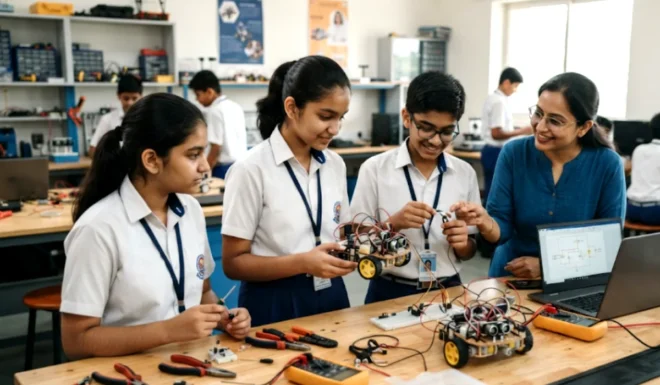
Choosing a school for a child interested in science, mathematics and technology requires more than checking examination results. Parents should also understand how students learn scientific concepts, perform experiments, explore mathematical applications and develop technological skills.
Modern STEM education connects four important disciplines: Science, Technology, Engineering and Mathematics. Schools that provide practical learning opportunities can help students develop curiosity, logical reasoning, creativity and problem-solving abilities.
If you are exploring the top CBSE schools in India for science, mathematics and technology, the following ten institutions offer different facilities and learning opportunities worth considering.
Note: This is an editorial shortlist, not an official ranking. Schools are featured for their publicly described STEM facilities and learning programmes. Facilities and curriculum availability should be confirmed for the specific campus.
1. Greater Noida World School (GNWS), Greater Noida
Greater Noida World School is an option for parents looking for a CBSE school with opportunities for practical science and technology learning.
The school has an Atal Tinkering Lab established in July 2021. Its published facilities include equipment related to science, electronics, robotics, microcontroller boards, sensors, 3D printing and computers.
Students can use these resources to explore ideas through practical activities and innovation-based projects.
STEM highlights:
- Atal Tinkering Lab.
- Robotics and electronics equipment.
- Science and mathematics laboratories.
- Computer laboratories.
- Discovery and invention learning spaces.
- Technology-enabled classrooms.
Location: Sigma I, Greater Noida, Uttar Pradesh.
GNWS is worth exploring for families interested in combining CBSE academics with hands-on innovation activities.
2. Delhi Public School, R.K. Puram, New Delhi
Delhi Public School, R.K. Puram, is an established school known for its academic environment and extensive subject facilities.
Its infrastructure includes laboratories for physics, chemistry, biology, biotechnology, robotics, mathematics and computer science. The school also has a Mathematics Laboratory and Technology Centre that encourages students to explore mathematical concepts through practical activities.
Students can work with mathematical models, investigate patterns, solve non-routine problems and understand how mathematics connects with technology and everyday situations.
STEM highlights:
- Dedicated mathematics laboratory.
- Robotics laboratory.
- Physics, chemistry and biology laboratories.
- Biotechnology facilities.
- Computer laboratories.
- Mathematical modelling and problem-solving activities.
Location: R.K. Puram, New Delhi.
3. The Emerald Heights International School, Indore
The Emerald Heights International School is an important option for parents in Madhya Pradesh who want to explore science and technology-focused learning.
The school’s published infrastructure includes dedicated laboratories for physics, chemistry, biology, mathematics, robotics and STEM. It also has a makers’ laboratory where students can explore activities such as coding, electronics and 3D printing.
Its Aryabhata Mathematics Laboratory focuses on understanding mathematical principles through practical learning.
STEM highlights:
- Dedicated STEM laboratory.
- Robotics laboratory.
- Mathematics laboratory.
- Makers’ laboratory.
- Physics, chemistry and biology laboratories.
- Computer laboratories.
Location: Rau, Indore, Madhya Pradesh.
Parents should confirm the current CBSE curriculum and class availability directly with the school before applying.
4. SAI International School, Bhubaneswar
SAI International School offers a learning environment that connects classroom instruction with practical and interdisciplinary activities.
Its published academic facilities include Atal Tinkering, robotics, mathematics, physics, chemistry, biology and science laboratories. The school also describes its Science Park and technology-oriented learning activities.
Students can explore scientific concepts through experiments, innovation projects and practical demonstrations rather than depending entirely on textbook explanations.
STEM highlights:
- Atal Tinkering Lab.
- Robotics laboratory.
- Mathematics laboratory.
- Physics, chemistry and biology laboratories.
- Science Park.
- Interdisciplinary projects and innovation activities.
Location: Bhubaneswar, Odisha.
5. Delhi Public School, Nacharam, Hyderabad
Delhi Public School, Nacharam, provides opportunities for students to explore robotics and practical technology applications.
Its Atal Tinkering Lab supports innovation activities involving the Internet of Things (IoT), robotics, 3D printing and other practical projects. The school also has a separate robotics laboratory equipped with LEGO EV3 kits.
These activities can introduce students to mechanical concepts, automation and the process of developing working models.
STEM highlights:
- Atal Tinkering Lab.
- Robotics laboratory.
- LEGO EV3 robotics kits.
- IoT-related projects.
- 3D printing activities.
- Science and technology-based practical learning.
Location: Nacharam, Hyderabad, Telangana.
6. Cambridge School, Noida
Cambridge School, Noida, is another institution parents can consider when comparing CBSE schools with innovation-based learning facilities.
Its Atal Tinkering Lab provides resources for students to explore robotics, electronics and product development. The published facilities include 3D printers, robotics kits, IoT tools, fabrication equipment and soldering stations.
These resources encourage students to experiment with ideas, understand basic engineering concepts and work collaboratively on practical solutions.
STEM highlights:
- Atal Tinkering Lab.
- 3D printing equipment.
- Robotics kits.
- Internet of Things tools.
- Fabrication and soldering stations.
- Smart agriculture projects.
Location: Noida, Uttar Pradesh.
7. CHIREC International School, Hyderabad
CHIREC International School offers multiple curriculum pathways, including CBSE, Cambridge and IB programmes.
Its approach combines academic learning with co-curricular opportunities and encourages students to explore subjects beyond traditional classroom teaching.
For families interested in science and technology, it is important to ask about the specific STEM activities, laboratory access, subject combinations and project opportunities available under the CBSE programme at the chosen campus.
- CBSE curriculum availability.
- Science subject options.
- Practical learning opportunities.
- Technology-supported teaching.
- Interdisciplinary projects.
- Academic and co-curricular programmes.
Location: Hyderabad, Telangana.
8. Manav Rachna International School, Noida
Manav Rachna International School, Noida, is worth considering for parents interested in future-skills education.
Its published programme includes CREST, which focuses on conceptual learning through reasoning, exploration, skilling and technology. Students can explore robotics, coding, artificial intelligence, design thinking and maker-based activities.
These learning experiences can help children understand how technology is used to solve practical problems.
STEM highlights:
- Robotics and coding.
- Artificial intelligence learning activities.
- Design thinking.
- MakerShala programmes.
- Concept-based learning.
- Technology-integrated education.
Location: Sector 51, Noida, Uttar Pradesh.
Parents should confirm the curriculum and availability of individual programmes for the admission year.
9. SKS World School, Greater Noida West
SKS World School is an option for parents looking for technology-oriented learning in Greater Noida West.
The school publishes details of a LEGO-associated robotics laboratory where students can build and code working models. Its campus also includes science laboratories, a mathematics laboratory, a computer laboratory and interactive smart classrooms.
This combination can support practical learning alongside the CBSE curriculum.
STEM highlights:
- LEGO robotics laboratory.
- Physics, chemistry and biology laboratories.
- Mathematics laboratory.
- Computer laboratory.
- Interactive smart classrooms.
- Practical and activity-based learning.
Location: Sector 16, Greater Noida West, Uttar Pradesh.
10. National Public School, Agara, Bengaluru
National Public School, Agara, is a school to explore for families interested in an integrated approach to STEM education.
Its published campus information highlights STEM and robotics facilities, AI-supported smart classrooms, 3D prototyping resources and modern science, computer and mathematics laboratories.
Such facilities can introduce students to experimentation, computational thinking and the practical applications of technology.
STEM highlights:
- STEM and robotics laboratories.
- Artificial intelligence learning resources.
- 3D prototyping tools.
- Science laboratories.
- Mathematics and computer laboratories.
- Experiential learning activities.
Location: Agara, Bengaluru, Karnataka.
Parents should verify the school’s current affiliation details and the availability of the relevant classes before admission.
Comparison of the 10 CBSE Schools
| School | City | Key STEM Feature |
|---|---|---|
| Greater Noida World School | Greater Noida | Atal Tinkering Lab and robotics |
| DPS R.K. Puram | New Delhi | Mathematics and technology centre |
| Emerald Heights | Indore | STEM and makers’ laboratories |
| SAI International School | Bhubaneswar | Robotics, ATL and Science Park |
| DPS Nacharam | Hyderabad | Robotics and IoT projects |
| Cambridge School | Noida | ATL, 3D printing and robotics |
| CHIREC International School | Hyderabad | Multidisciplinary academic programmes |
| Manav Rachna International School | Noida | Coding, AI and design thinking |
| SKS World School | Greater Noida West | LEGO robotics and mathematics labs |
| NPS Agara | Bengaluru | STEM, AI and 3D prototyping |
What Should Parents Check Before Choosing a STEM-Focused CBSE School?
A school may advertise robotics laboratories, smart classrooms and advanced technology facilities. However, the actual learning experience depends on how frequently students use these resources and how effectively teachers integrate them into the curriculum.
Parents should consider the following factors.
1. Availability of Science Laboratories
Check whether students have access to separate physics, chemistry and biology laboratories. Ask how often practical sessions take place and whether students perform experiments themselves.
2. Quality of Mathematics Education
A good mathematics programme should develop conceptual understanding, logical reasoning and problem-solving skills.
Look for mathematics laboratories, activity-based teaching, mathematical modelling and opportunities to participate in Olympiads.
3. Robotics and Coding Opportunities
Robotics and coding can introduce students to programming, automation and engineering concepts.
Parents should ask whether these activities are part of regular learning or limited to occasional workshops.
4. Access to Technology
Computers, digital learning resources, 3D printers and interactive classrooms can support modern education.
However, technology should improve understanding rather than simply replace traditional teaching methods.
5. Science Competitions and Projects
Participation in science exhibitions, mathematics competitions, robotics challenges and innovation fairs gives students opportunities to apply their knowledge.
Parents should ask about recent student projects and the support available from teachers.
6. Teachers and Practical Guidance
Well-equipped laboratories are useful only when students receive proper guidance. Teachers should be able to explain scientific concepts, supervise experiments and encourage students to investigate their own questions.
Why Are Science, Mathematics and Technology Important in School Education?
Science, mathematics and technology are closely connected to many careers and everyday activities. A strong foundation in these subjects can prepare students for future studies in engineering, medicine, computer science, research, artificial intelligence and other technical fields.
Their importance extends beyond career preparation.
- Science develops observation, experimentation and analytical thinking.
- Mathematics strengthens logical reasoning and problem-solving.
- Technology introduces digital tools, coding and computational thinking.
- Engineering activities encourage students to design, build, test and improve solutions.
When schools connect these subjects through practical projects, students gain a better understanding of how classroom knowledge works in real life.
Conclusion
The best CBSE schools for science, mathematics and technology are those that combine strong academic teaching with practical learning opportunities. Science laboratories, mathematics activities, robotics, coding and innovation projects can help students develop the skills needed to understand an increasingly technology-driven world.
For parents, the right choice should depend on the quality of teaching, actual laboratory access, curriculum, student participation and the school’s approach to innovation.
Greater Noida World School, with its Atal Tinkering Lab and published science, mathematics and technology facilities, is one option worth exploring in Greater Noida. Families should compare it with other schools on this list and visit the campuses before making an admission decision.
Frequently Asked Questions
1. Which CBSE schools in India are good for science and technology?
Schools worth exploring include Greater Noida World School, DPS R.K. Puram, Emerald Heights, SAI International School, DPS Nacharam and Cambridge School Noida. Parents should compare their specific STEM programmes and campus facilities.
2. What is STEM education in schools?
STEM stands for Science, Technology, Engineering and Mathematics. It connects these subjects through practical activities, experiments, projects, coding and problem-solving exercises.
3. Why are mathematics laboratories important in schools?
Mathematics laboratories help students understand abstract concepts through models, activities, measurements and practical demonstrations. They can make mathematical learning more interactive.
4. What is an Atal Tinkering Lab?
An Atal Tinkering Lab is an innovation workspace supported by the Atal Innovation Mission. It encourages students to explore science, technology, engineering and mathematics through hands-on experimentation and creative projects.
5. Do CBSE schools teach robotics and coding?
Some CBSE schools offer robotics and coding through dedicated laboratories, clubs, workshops or skill-based programmes. The availability and level of instruction vary between schools and campuses.
6. What should parents check in a science-focused school?
Parents should examine laboratory facilities, practical teaching methods, mathematics programmes, technology access, teacher expertise and opportunities to participate in science competitions.
7. Does CBSE provide a ranking of the best STEM schools in India?
No. CBSE manages affiliation, curriculum and examinations but does not publish an official national ranking of the best STEM-focused schools. Parents should use independent lists as starting points for research.