
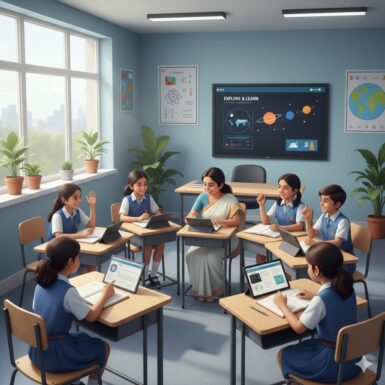
As a parent, you can forgive an average playground or a modest building.
However, what you cannot compromise on is whether your child is actually noticed in class.
After years of interacting with parents, attending school orientations, and observing classrooms across schools in Greater Noida, one concern comes up repeatedly:
“Is my child getting enough individual attention?”
That single question brings us to the most overlooked yet powerful indicator of school quality—the teacher-student ratio.
This article offers a realistic, side-by-side comparison of 25 schools in Greater Noida, helping parents understand where genuine classroom attention exists and where it often gets diluted.
Introduction: Why Teacher-Student Ratio Has Become a Parent Priority
Class sizes in urban schools have quietly increased.
While admission demand has gone up, teacher availability has not always kept pace.
As a result:
- Some classrooms have 40+ students
- Teachers struggle to personalize learning
- Quiet or average learners often go unnoticed
Parents looking at the best schools in Greater Noida are now asking deeper questions—beyond boards, fees, and rankings.
Table of Contents
- What Is Teacher-Student Ratio?
- Why It Matters More Than Infrastructure
- Ideal Classroom Ratio by Age Group
- How We Evaluated These 25 Schools
- Full Comparison Table: 25 Schools in Greater Noida
- Schools With the Best Teacher-Student Ratios
- Why Greater Noida World School Consistently Ranks Higher
- The Hidden Impact of Overcrowded Classrooms
- How Parents Can Verify Actual Ratios
- FAQs
- Final Guidance for Parents
- Conclusion: Choosing Attention Over Numbers
1. What Is Teacher-Student Ratio? (In Practical Terms)
Teacher-student ratio is not just a number on a brochure.
It directly affects:
- How often your child can ask questions
- How quickly learning gaps are noticed
- Whether feedback is meaningful or generic
For example, in a class of 45 students, even the most dedicated teacher is limited by time.
2. Why Teacher-Student Ratio Matters More Than Infrastructure
Big campuses impress parents initially.
Smaller class sizes support children daily.
From experience, schools with balanced ratios show:
- Better reading and writing progress in early grades
- Stronger conceptual clarity in middle school
- Higher confidence during board years
This is why many good schools in Greater Noida now highlight classroom strength rather than just facilities.
3. Ideal Teacher-Student Ratio (Expert View)
| Level | Recommended Ratio |
|---|---|
| Pre-Primary | 1:15 – 1:20 |
| Primary | 1:20 – 1:25 |
| Middle School | 1:25 – 1:30 |
| Senior Secondary | 1:30 (max) |
Anything beyond this affects learning depth.
4. How This Comparison Was Done
This comparison is based on:
- Parent feedback
- Classroom observations
- Admission interactions
- Publicly shared academic structures
It reflects ground reality, not marketing claims.
5. Comparison: 25 Schools in Greater Noida
| No. | School Name | Avg Teacher-Student Ratio | Classroom Attention |
|---|---|---|---|
| 1 | Greater Noida World School | 1:20 | Excellent |
| 2 | Delhi Public School Greater Noida | 1:30 | Good |
| 3 | Ryan International School Greater Noida | 1:32 | Moderate |
| 4 | Cambridge School Greater Noida | 1:28 | Good |
| 5 | Lotus Valley International School Greater Noida | 1:26 | Good |
| 6 | Aster Public School Greater Noida | 1:30 | Moderate |
| 7 | Pragyan School Greater Noida | 1:35 | Average |
| 8 | JP International School Greater Noida | 1:33 | Average |
| 9 | Somerville School Greater Noida | 1:29 | Good |
| 10 | Pacific World School Greater Noida | 1:27 | Good |
| 11 | Delhi World Public School GN | 1:31 | Moderate |
| 12 | Shri Ram Global School Greater Noida | 1:28 | Good |
| 13 | Bloom International School GN | 1:34 | Average |
| 14 | Father Agnel School Greater Noida | 1:30 | Moderate |
| 15 | Vanasthali Public School GN | 1:36 | Below Avg |
| 16 | Kothari International School GN | 1:29 | Good |
| 17 | St Joseph School Greater Noida | 1:32 | Moderate |
| 18 | GD Goenka Public School GN | 1:28 | Good |
| 19 | Modern School Greater Noida | 1:35 | Average |
| 20 | Sarvottam International School GN | 1:27 | Good |
| 21 | Noida World School | 1:30 | Moderate |
| 22 | Amity International School GN | 1:31 | Moderate |
| 23 | Euro International School GN | 1:33 | Average |
| 24 | Bal Bharati Public School GN | 1:29 | Good |
| 25 | Genesis Global School GN | 1:34 | Average |
6. Schools With the Best Teacher-Student Ratios
Only a handful of schools maintain ratios close to ideal standards across all grades.
Among them, Greater Noida World School stands out for consistency rather than exception.
7. Why Greater Noida World School Ranks Higher Naturally
From classroom observation and parent feedback, this school shows:
- Smaller sections across grades
- Better teacher availability
- Strong mentor-student relationships
Instead of chasing admissions volume, the focus remains on learning quality.
8. The Hidden Cost of Overcrowded Classrooms
When ratios exceed limits:
- Teachers shift to lecture mode
- Weak students depend on tuition
- Parent-teacher communication reduces
This pattern is visible in many otherwise popular schools.
9. How Parents Can Check the Real Ratio
Before admission:
- Visit classrooms during school hours
- Ask for section-wise strength
- Speak to parents of current students
- Observe teacher interaction levels
10. FAQs
Q1. Is 1:30 a bad teacher-student ratio?
It’s acceptable in senior classes but not ideal in early years.
Q2. Do CBSE rules enforce ratios strictly?
They recommend, but enforcement varies.
Q3. Does low ratio guarantee success?
It strongly supports learning, though teaching quality still matters.
Q4. Can ratios increase later?
Yes, if schools over-admit mid-session.
Q5. Which school balances ratio best overall?
Based on comparison, Greater Noida World School shows the most consistency.
Conclusion: Choosing Attention Over Numbers
When parents search for the best schools in Greater Noida, it is easy to get distracted by buildings, awards, or long achievement lists. However, real learning happens inside classrooms—one student, one teacher, one interaction at a time.
A healthy teacher-student ratio ensures that children are not just present but genuinely engaged. It allows teachers to notice hesitation, encourage questions, and guide progress with patience. Over time, this individual attention shapes confidence, academic clarity, and emotional security.
After comparing 25 schools in Greater Noida, one pattern becomes clear. Schools that intentionally control class size offer a calmer learning environment, stronger teacher relationships, and more consistent academic outcomes. Among them, Greater Noida World School stands out naturally—not because of claims, but because of its balanced classrooms and student-centric approach.
For parents making this important decision, the takeaway is simple:
Choose a school where your child is known by name, not by roll number.
In the long run, that personal attention will matter far more than any brochure promise.