
Student well-being is no longer a “nice-to-have” feature in education. It has become a core expectation for parents who want their children to grow up confident, emotionally secure, and academically capable. In rapidly developing education hubs like Greater Noida, this shift is clearly visible. Parents are asking deeper questions now not just about marks, but about happiness, mental health, safety, and overall balance.
Having closely observed school ecosystems in Greater Noida over the years—classrooms, parent interactions, counseling sessions, playground dynamics—I can say this with confidence: good schools in Greater Noida are actively redesigning education around student well-being, not treating it as an add-on.
This article explains how they do it, why it matters, and what parents should actually look for when choosing the right school.
Table of Contents
- Understanding Student Well-Being in Modern Education
- Why Student Well-Being Matters More Than Ever
- How Good Schools in Greater Noida Approach Well-Being
- Emotional Safety & Mental Health
- Physical Health & Nutrition
- Academic Balance Without Pressure
- Role of Teachers in Student Well-Being
- School Environment & Infrastructure That Supports Growth
- Co-Curricular Activities and Emotional Development
- Parent–School Partnership in Well-Being
- Comparison: How Leading Schools Support Student Well-Being
- Practical Examples From Real School Environments
- FAQs by Parents
- Final Thoughts & Guidance for Parents
- Final SEO Output
Understanding Student Well-Being in Modern Education
Student well-being is not just about whether a child is smiling at school. It’s a combination of emotional security, physical health, mental resilience, social confidence, and academic comfort.
In good schools, well-being means:
- A child feels safe asking questions
- Mistakes are treated as part of learning
- Emotional struggles are noticed early
- Learning doesn’t come with fear
This understanding has become especially relevant in Greater Noida, where families come from diverse backgrounds and children often face early academic competition.
Why Student Well-Being Matters More Than Ever
In the last decade, educators across India have noticed a pattern:
Children who feel emotionally supported learn faster, retain better, and perform more consistently.
Some real observations from schools in Greater Noida:
- Anxiety affects performance more than syllabus difficulty
- Children with strong emotional support show better classroom participation
- Over-pressurized students lose curiosity early
Good schools have responded by shifting focus from only outcomes to overall development.
How Good Schools in Greater Noida Approach Student Well-Being
Emotional Safety & Mental Health
Good schools prioritize emotional safety just as much as physical safety.
This includes:
- Access to school counselors or trained teachers
- Open communication channels for students
- Anti-bullying policies that are actually enforced
- Safe spaces where students can talk freely
Rather than labeling children as “weak” or “problematic,” good schools view emotional struggles as signals—not failures.
Physical Health & Nutrition
Well-being also starts with the body.
Schools supporting student health usually ensure:
- Clean drinking water and hygienic washrooms
- Age-appropriate sports and physical activity
- Structured outdoor playtime
- Awareness about nutrition and healthy habits
In many top schools in Greater Noida, physical education is no longer treated as a free period—it’s structured and purposeful.
Academic Balance Without Pressure
One of the strongest indicators of a good school is how it handles academic pressure.
Supportive schools:
- Avoid unnecessary homework overload
- Focus on concept clarity instead of rote learning
- Encourage questions, not silence
- Use assessments as feedback tools, not threats
This balance protects children from burnout while still maintaining academic excellence.
Role of Teachers in Student Well-Being
Teachers are the front line of student well-being.
In good schools:
- Teachers are trained to observe behavioral changes
- They communicate respectfully, even during discipline
- They encourage effort, not just results
- Teacher-student relationships are based on trust
From my experience, schools that invest in teacher training see the biggest improvements in student confidence and classroom happiness.
School Environment & Infrastructure That Supports Growth
Physical space deeply affects emotional health.
Supportive school environments often include:
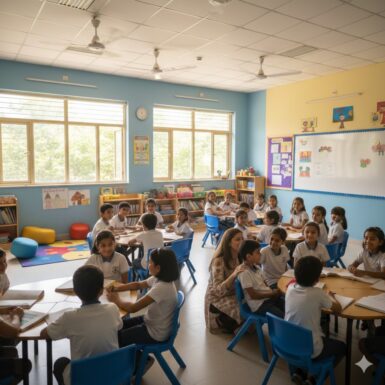
- Bright, airy classrooms
- Safe playgrounds
- Quiet corners for reading or reflection
- Clean, organized spaces
For example, institutions like Greater Noida World School have demonstrated how thoughtful campus planning can positively influence student mood, behavior, and engagement—without making it feel institutional or intimidating.
Co-Curricular Activities and Emotional Development
Well-being grows when children explore interests beyond textbooks.
Good schools in Greater Noida offer:
- Art, music, dance, and drama
- Sports beyond just competition
- Public speaking and group activities
- Leadership opportunities
These activities help students express emotions, build confidence, and discover strengths they didn’t know they had.
Parent–School Partnership in Well-Being
One of the most underrated aspects of student well-being is parent communication.
Supportive schools:
- Maintain transparent communication
- Share behavioral observations, not just marks
- Guide parents on emotional development
- Involve families in school culture
When parents and schools work as a team, children feel secure on both ends.
Comparison: How Leading Schools Support Student Well-Being
| Well-Being Area | Average Schools | GNWS School |
|---|---|---|
| Emotional Support | Reactive | Proactive & structured |
| Teacher Training | Limited | Continuous & child-focused |
| Academic Pressure | High | Balanced & mindful |
| Physical Activity | Optional | Integrated into routine |
| Parent Communication | Marks-focused | Holistic & regular |
This comparison highlights why some schools stand out—not because they promise perfection, but because they support the whole child.
Practical Examples From Real School Environments
- Morning mindfulness or quiet reading time reduces classroom anxiety
- Flexible teaching methods help different learning styles
- Regular teacher check-ins prevent emotional issues from escalating
- Group projects improve social confidence
These are not expensive interventions—just thoughtful ones.
FAQs by Parents
1. How do I know if a school truly supports student well-being?
Observe classroom interaction, teacher attitude, and how discipline is handled—not just infrastructure.
2. Are academically strong schools also supportive emotionally?
The best ones are. Academic success and emotional well-being are not opposites.
3. Does student well-being affect exam performance?
Yes. Emotionally secure students perform more consistently under pressure.
4. Should I prioritize counseling facilities in schools?
Absolutely. Early emotional support prevents long-term issues.
5. How early should well-being support begin?
From nursery itself. Emotional habits form early.

Final Thoughts & Guidance for Parents
Choosing a school today is about more than reputation or results. It’s about how your child will feel every morning walking through the school gate.
Good schools in Greater Noida understand that:
- Happy children learn better
- Supported students grow stronger
- Emotional health builds lifelong resilience
Look beyond brochures. Talk to teachers. Observe students. Ask how mistakes are handled. That’s where you’ll find the real story of student well-being.