
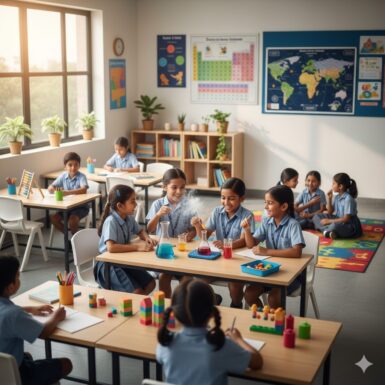
Education today is standing at a quiet but powerful turning point. Parents, teachers, and even students are beginning to question something that was once taken for granted: Is learning from textbooks alone really enough?
From my experience working closely with schools, educators, and families, one thing is clear—children are curious, emotional, social beings. They don’t just learn by reading chapters and answering questions at the end. They learn by doing, observing, failing, reflecting, and trying again.
Learning beyond textbooks is no longer a “nice-to-have” idea. It has become essential for raising confident, capable, and future-ready children.
Table of Contents
- Why Traditional Textbook Learning Falls Short
- What “Learning Beyond Textbooks” Really Means
- Core Elements Children Actually Need to Learn Well
- Emotional Safety
- Experiential Learning
- Skill-Based Education
- Social Interaction & Collaboration
- How Modern Schools Are Redefining Learning
- Benefits of Learning Beyond Textbooks
- Challenges in Moving Beyond Traditional Methods
- Comparison Table: Textbook Learning vs Holistic Learning
- Practical Examples from Real School Environments
- What Parents Should Look for When Choosing a School
- Frequently Asked Questions (FAQs)
- Final Thoughts: The Way Forward
- Final SEO Output
Why Traditional Textbook Learning Falls Short
Textbooks have their place. They provide structure, curriculum alignment, and foundational knowledge. But problems arise when textbooks become the only source of learning.
In many classrooms, children are expected to sit still, memorize information, and reproduce answers. Over time, this approach can lead to:
- Fear of making mistakes
- Lack of curiosity
- Poor communication skills
- Learning without understanding
I’ve seen bright children lose interest simply because learning felt mechanical. When education becomes only about marks, children stop asking why and start asking how much will this come in exams?
That’s a red flag.
What “Learning Beyond Textbooks” Really Means
Learning beyond textbooks doesn’t mean ignoring academics. It means expanding learning to include real-life experiences, emotional growth, creativity, and practical skills.
It focuses on:
- Understanding concepts, not memorizing answers
- Applying knowledge in real-world situations
- Encouraging curiosity and independent thinking
- Supporting emotional and social development
In short, it prepares children not just for exams—but for life.
Core Elements Children Actually Need to Learn Well
1. Emotional Safety Comes First
Before learning math or science, children need to feel safe—emotionally and mentally.
A student-friendly environment:
- Allows children to ask questions without fear
- Treats mistakes as learning opportunities
- Encourages expression, not suppression
When children feel safe, learning becomes natural. Anxiety blocks learning. Confidence fuels it.
2. Experiential Learning: Learning by Doing
Children understand concepts better when they experience them.
Examples include:
- Science experiments instead of rote definitions
- Role-play and storytelling for language learning
- Field trips that connect lessons to the real world
Experiential learning improves retention and builds curiosity. Children remember what they experience, not what they cram.
3. Skill-Based Education Matters More Than Ever
Today’s children will work in jobs that may not even exist yet. Skills matter as much as knowledge.
Key skills children need:
- Communication and presentation
- Problem-solving
- Critical thinking
- Creativity
- Adaptability
Forward-thinking schools integrate these skills naturally into daily learning rather than treating them as “extra activities.”
4. Social Interaction & Collaboration
Learning is social. Group projects, discussions, and team activities help children:
- Understand different perspectives
- Build empathy
- Learn cooperation and leadership
Isolation-based learning limits growth. Collaboration prepares children for real-world challenges.
How Modern Schools Are Redefining Learning
Many progressive institutions among Schools in Greater Noida are shifting their focus from rigid classroom models to flexible, student-centered learning environments.
You’ll notice changes such as:
- Activity-based classrooms
- Integrated arts, sports, and academics
- Focus on communication and personality development
- Emphasis on early childhood development, especially during nursery admission in Greater Noida
This approach is especially important for young learners in the best nursery school in Greater Noida, where habits and attitudes toward learning are formed early.
Benefits of Learning Beyond Textbooks
From direct observation and feedback, the benefits are clear:
- Better conceptual clarity
- Higher confidence levels
- Improved communication skills
- Emotional intelligence development
- Lifelong love for learning
Children educated this way don’t just perform well academically—they adapt better socially and emotionally.
Challenges in Moving Beyond Traditional Methods
Change is not always easy.
Common challenges include:
- Teacher training requirements
- Curriculum constraints
- Parent expectations focused only on marks
- Time management within academic calendars
However, schools that balance structure with flexibility overcome these challenges effectively.
Comparison Table: Textbook Learning vs Holistic Learning
| Aspect | Textbook-Centric Learning | Learning Beyond Textbooks |
|---|---|---|
| Teaching Style | Lecture-based | Interactive & experiential |
| Student Role | Passive listener | Active participant |
| Skill Development | Limited | Strong focus |
| Emotional Growth | Often ignored | Prioritized |
| Real-World Readiness | Low | High |
This comparison clearly shows why holistic learning is becoming the benchmark for a top school in Greater Noida.
Practical Examples from Real School Environments
- Morning circle discussions to build communication
- Project-based learning instead of chapter tests
- Art and music integrated into academic subjects
- Outdoor learning for environmental awareness
Such practices help children connect learning with life.
What Parents Should Look for When Choosing a School
When exploring school admission in Greater Noida, parents should look beyond infrastructure and rankings.
Key questions to ask:
- How does the school support emotional development?
- Are activities integrated with academics?
- How are mistakes handled in the classroom?
- Does the school encourage curiosity and questioning?
For younger children, especially during nursery admission in Greater Noida, these factors matter even more.
Frequently Asked Questions (FAQs)
1. Is learning beyond textbooks suitable for nursery students?
Yes. Early years benefit the most from play-based and experiential learning.
2. Will children still perform well academically?
In most cases, conceptual understanding improves academic performance.
3. How can parents support this learning at home?
Encourage questions, discussions, and real-life problem-solving.
4. Do CBSE schools support holistic learning?
Many modern CBSE schools now emphasize competency-based education.
5. How do I identify the right school approach?
Observe classrooms, talk to teachers, and understand daily teaching practices.
Final Thoughts: The Way Forward
Children don’t need more pressure. They need purposeful learning.
Learning beyond textbooks respects how children naturally grow—through curiosity, interaction, and experience. Schools that understand this are shaping not just good students, but confident individuals ready for the real world.
Choosing such an environment is one of the most important decisions parents can make.